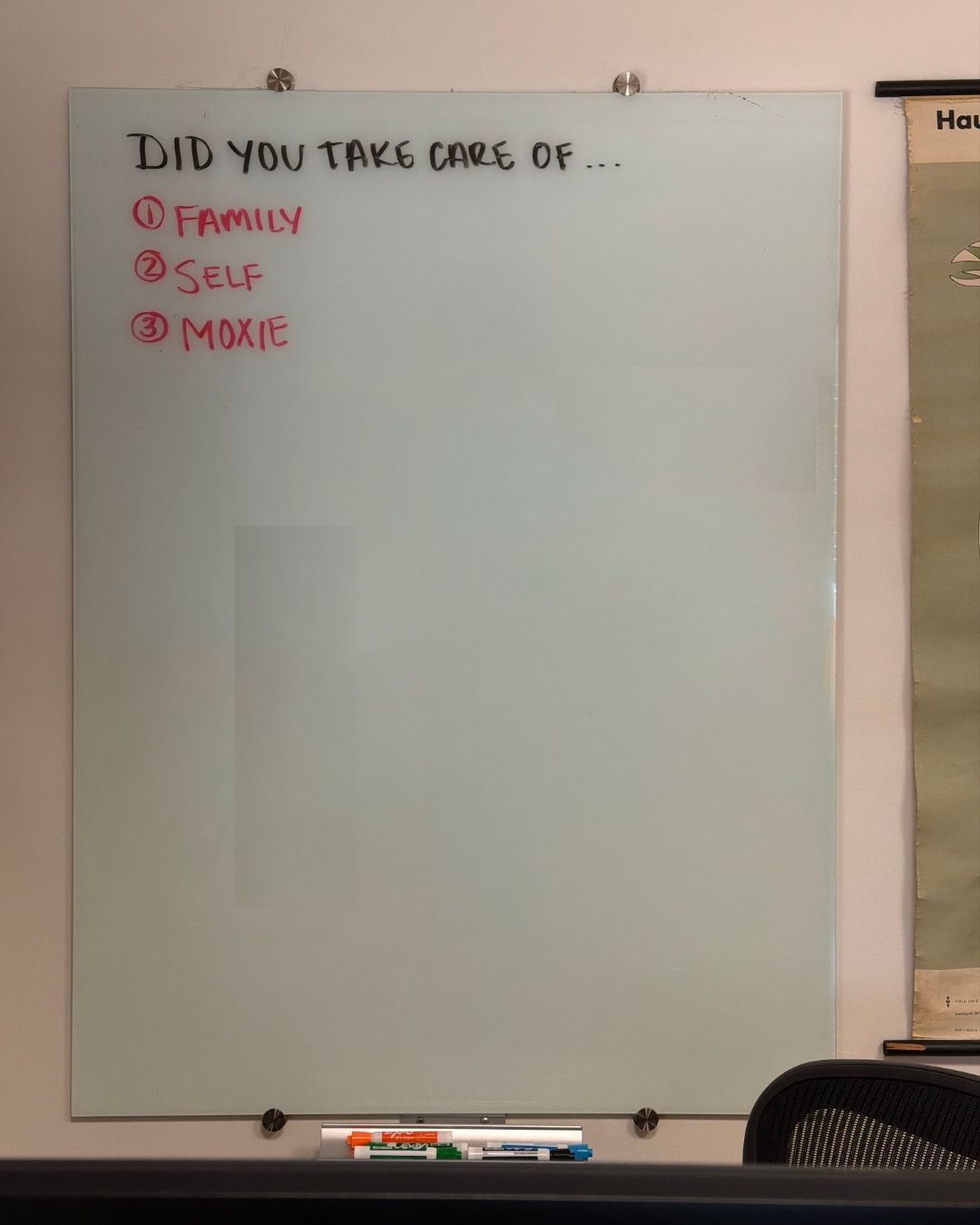
There’s a list I keep on the whiteboard in my office. I look at it every single day. No, it’s not a list of deliverables or KPIs or anything a business consultant would get excited about. It’s three words posed as a question.
Did you take care of…
Family?
Self?
Moxie Sozo?
In that order.
I keep it on the wall because I actually don’t trust myself to remember it. Not the believing part…I believe it whole-heartedly. It’s the living part that’s hard. Most of us sorta figure it out the deeper we get into a career. The order you say out loud is in direct conflict with the order your calendar actually keeps. And running a business makes it even harder, because the first two things on that list can be directly tethered to the success of the third. If the agency struggles, my family feels it. If I’m fried, the agency feels it. The three priorities aren’t really fighting over my focus as much as they’re relying on each other.
Let’s be honest about the one in the middle, because Self always gets the short end of the stick. Of the three, it’s the hardest for me to actually get right. Family is easy to rally for. It's the people you love, the kids that need you to show up daily…the stakes are obvious and I love them so much (Britt, Briar, and Hayes…you’re the best of me). The agency screams for attention all day long (team and clients, that’s not a bad thing, just the truth).
But Self? Self is quiet. So it’s the first thing I give away. Every. Single. Time. I’d bet I’m not alone in that. Here’s what I’m still learning after 16 years though: skipping that mid-day walk to decompress, eating like garbage or skipping a meal because I’m stressed (I had someone offer me lunch today and I said no, why did I say no, what I was working on wasn’t more important than eating), running on four hours of sleep so I can give more to family and Moxie. That’s not noble. It’s slowly knocking the legs out from under the stool. Self isn’t defined as the “selfish” item on the list, but it bears the biggest weight.
The version of me my family gets, and the version our team gets, both depend on me bothering to maintain the person in the mirror.
So no, I don’t hit that order every day. Absolutely not. Some days Moxie Sozo elbows its way to the top and Family and Self stand in line, and I go home knowing I got it backwards. The list isn’t on my wall because I’ve mastered it…more because I haven’t. The reminder is the whole point.
Which brings me to something I’ve been reflecting on for a while. I never set out to be a
CEO. I started at this place as an unpaid intern. I wasn’t angling for the big creative title, the nice office, or the next job. I was just trying to be useful (you’re welcome for cutting out that label
Charles) and not get fired (probably shouldn’t have thrown a kegger in the office, but whatever…it was for Self’s sanity). I never once said “I want to manage people.” I never pictured myself as the person making calls that ripple through our agency and the lives of everyone in it. But here I am. And I’ll tell you plainly, I struggle with it. I fuck it up all the time. I fear I’m letting down all three priorities at once. There are days I’m certain someone else would be better at this part of the job than I am.
For years I treated that feeling as a flaw. The hesitation, the constant second-guessing, the fact that I’ve never had any real appetite for being “the one in charge.” Then I ran into
something Steve Jobs said back in 1985, and it has rearranged how I think about it all.
Paraphrasing, he said the best managers are the great individual contributors who never wanted the job in the first place, but took it on anyway because nobody else was going to do it as well. The ones who are good at it don’t crave it. They do it because they care about what needs to be done more than the title or recognition, and because someone who’s in it for the power would let the work suffer. When I read that, something I’d identified as a weakness suddenly looked like the opposite. If you never wanted the authority, you’re a lot less likely to confuse power with being right. You stay close to the actual work (or try your damndest). You keep asking whether you’re really the right person to be making the call, which is a question the power-hungry tend to quit asking the day they get the big promotion.
I hesitate to translate this effect to client service, because the second you do it starts to sound like a pitch, and I’m not pitching. But that same instinct is what I want to be true of how we handle the businesses our clients trust us with. I’m not going to claim we’re better than everyone else at it. What I will say is that I want the people working on your account to care more about the work’s quality than the agency’s authority. I want a team that isn't so exhausted it stops giving a damn. Do we always get there? No. I miss the order on the whiteboard plenty of weeks. But it’s the standard I’m trying to hold us to, and I’d rather be judged against a bar I sometimes fall short of than pretend we clear it every time.
Back in the intern days I just wanted everything to be great. If I thought I could make something better, a project, a client relationship, hell even somebody’s bad day, I jumped in. “Of course, I’ll help” was my answer to almost anything. That’s come with a lot of late nights and a fair number of sacrifices, some of which I remember and a few I’d rather not. I’m not holding it up as a badge. It’s the same reflex that knocks my whiteboard out of order. But it comes from the place Jobs was getting at: caring more about whether the thing is good than about who’s running the show or how it gets done.
So here’s what I want everybody at
Moxie Sozo to hear, the same way I need that whiteboard yelling it at me. You don’t need all the answers, or a hunger for the title, or a clean record of getting your priorities right. You just have to give enough of a shit…about each other, about the work, and about the clients who bet on us. And you have to take care of yourself well enough to keep showing up as your best Self.
I’ll keep staring at that list. I’ll keep getting it wrong some weeks. And I’ve mostly made peace with the idea that the reluctance I used to count against myself might be the best thing I bring to this place.
Special thanks to Lindsay Connors, for advising me to reflect on that list and why I wrote it in the first place.
%20(2).png)

-1.png)